
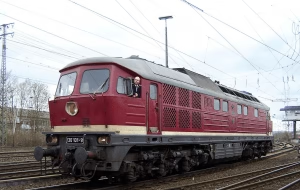
Good companyANDTEHMIN has created a system that helps Qimproving the energy consumption of the ventilation of electric traction motors in the 2,100 HP locomotives manufactured Qn 1959. It is the third in a series of four innovations by the company, designed to ensure the operation of locomotives at least Q15-20 years from now Qover there.

The innovation of the company braANDovene comes to eliminate the disadvantages of the current ventilation system. One of the disadvantages is that the air flow for ventilation is constant, regardless of the level of demand on the traction motors. There are only two operating modes, namely summer-winter.
Electric ventilation motors are direct current, requiringând a large volume of labor for Qmaintenance. Another disadvantage is that the ventilation system has a high energy consumption (two motors with a power of 2×16 kW). Location of ventilation Qn the front parts of the diesel engine-generator group affect access Qin those areas. In addition, the electrical contactors are direct current, requiringâspare parts ANDand large volume of labor.
The new source of electric ventilation
The new solution usesANDself-piloted electric ventilation motors, of modern construction, with automatic regulation according to an established algorithm Qbetween the current on traction motors ANDand ambient temperature. The proposal of the TEHMIN company involves the installation ofâan electric motor with fan on each existing ventilation screw, with a power of 5kW for the ventilation of two traction motors ANDi of 3kW for a traction motor. The air flow rate is a function of the two parameters mentioned.
As advantages, the authors of the innovation list: electric motors do not require maintenance work Qmaintenance or consumables, the electrical power system has no contactors, the energy consumption for ventilation is approximately three times lower, whichANDaccessibility Qn the front parts of the diesel engine ANDand generators. No Qin the last yearând, the installed electrical power is reduced from 32 kW to 16 kW.

With 100,000 euros invested that is amortized QIn 12-22 months, a locomotive still livesANDat least 15-20 years
Good companyANDThe Romanian company has developed a set of four innovations that bring old things back to life.âthe classic LDE locomotives from 1959.
The mentioned systems have been implemented on the locomotives of important operators on the Romanian market.âPeasant ANDand ANDthey showed its efficiency, says PhD engineer Mihai Marcu, the company's administrator ANDand the coordinator of the implementation of these innovations. Mihai Marcu was an engineer ANDand director QWithin the CFR Bra regionalANDegg ANDand after decades of operating locomotives he became an expert Qin their exploitation.
What do the other three innovations entail?
We remind you that first system, recently presented by Club Feroviar, involves the installation of a special generator set, which will take over the running Qn empty if the locomotive is not Qin traction mode. The generator set is the third “inexhaustible” energy source of the locomotive that takes over Qn all the functions of the diesel traction engine câthis works Qidling for periods longer than 30 minutes, and the locomotive does not develop traction. This, without limiting the functions Qn stayÞDriven or Qby train or isolated.
The third energy source has two operating modes. Când the locomotive is active, the control is manual ANDand carried out by the mechanic who decidesANDyou, QDepending on the operating conditions, which diesel engine is operating. CâWhen the locomotive is drawn, the command is automatic. Qdepending on the coolant temperature ANDand the voltage of the battery. We must have QConsidering that this locomotive will be operated for about 20 more years.

The annual operating time of a locomotive is Qan average of 5,800 hours. A reduction in running time on the 50% achieved by carrying out the modernizations leads to a saving of about 25 tons per year ANDand locomotive, respectively 12.5 kilograms of oil per ton of fuel, and the system maintenance represents less than 51% of that of the traction diesel engine.
A second innovation assume QReplacing the hydrostatic system. To keep the temperature of the cooling circuit under control, Diesel engines rely on a hydrostatic system that includes, among others – a pump, a hydrostatic motor ANDand a regulator, respectively two hydraulic cylinders for Qclosing ANDand opening the exterior blinds.
The hydrostatic pump operates continuously, regardless of the diesel engine's thermal regime, and the hydrostatic regulator operates with large deviations from the optimal coolant temperature values of 60 degrees Celsius. Due to the "chimney" effect of the cooling tank, the radiators evacuate a large part of the heat când the temperature is below the minimum optimal value ANDand keeping the engine warm. This results in high costs due to additional fuel consumption, whenând the engine is operating below the minimum optimum temperature, but ANDand for keeping the engine warm and for operating Qn empty of the hydrostatic installation.
The high costs come from ANDand from Qmaintenance of the hydrostatic system, i.e.: oil, spare parts ANDand maintenance. The harmful effects of overconsumption of diesel below the optimum temperature are atât excessive environmental pollution, cât ANDand the production of a large amount of scale which createsANDaccelerates the wear rate of the diesel engine, causes the infestation of the lubricating oil ANDand degradation of the fine oil filter. The hydrostatic installation is a highly energy-consuming auxiliary service with significant detrimental effects on fuel consumption.
To eliminate these disadvantages, TEHMIN engineers have gâI created a system Qin which the hydrostatic installation is Qreplaced by four electric fans, câtwo on each radiator branch, fitted with internal blinds. The external blinds ANDThe interior doors are operated with servomotors that Qclose or open Qdepending on the coolant temperature ANDand are controlled by temperature sensors by a central controller.
The new system reduces the nominal power from about 30kW (cât has the hydrostatic installation) at 9kW (cât has the new electrical ventilation system), and the average hourly energy is about 2kWh, the operating time Qbetween 50 and 60% ANDand maintenance is reduced by over 80% compared to the hydrostatic installation.
A fourth system What will be presented by our publication is a locomotive diagnosis system, Qdata recording ANDand their transmission to the ground.
TEHMIN-BRASOV, the company dedicated to innovation in rolling stock
TEHMIN-BRASOV is a company Qestablished Qin 2002, out of the desire to put Qin practice a series of technical ideas Qin the field of rolling stock. The company's entire production is based on research ANDand innovation ANDand is intended for construction, modernization companies ANDand railway operation, but with possibilities for expansion ANDand other fields. TEHMIN is involved Qin the design ANDand delivery of specific solutions for electrical systems; management, control ANDand train diagnostics; communication systems ANDand passenger information systems, bothât for new trains, cât ANDand for those found Qin operation.
The activity is supported by three design departments: electrical ANDand automation, electronicsUm ANDand mechanics, with their laboratories. They beginâSince 2011, TEHMIN is involved ANDand Qn repairs of various subsystems (displays, air conditioning control units, toilet control, u controlANDi, sources, converters, inverters etc.).
The company ANDIt set as its objective the modernization of locomotives, railcars, passenger cars or other railway equipment, pursuing four main directions of activity:
- reducing energy consumption ANDand fuel QIn the process of operating the motor rolling stock, Qin order to reduce pollution ANDtake the transportation costs;
- mechanization ANDand automation of orders on railway vehicles with the aim of optimizing order processes ANDand operation ANDand putting Qn evidencing any deviations Qin real time;
- reducing maintenance costs ANDand believeANDincreasing product reliability ANDtake safety Qin rail transport;
- digitalization of the rolling stock operation process, atâtechnical, cât ANDand economical.
Engineer Mihai Marcu hopes that TEHMIN solutions will be implemented byât several companies in the railway field, with atâmore with cât such projects have ANDchances of receiving ANDand European funding for environmental protection. "Let's have QGiven that the transport sector is essential QIn the development of modern society, it must be reliable, efficient, safe ANDand ecological, I doâwhen Qin this way the journeys ANDand safer goods transport. The four solutions we propose are Qframe Qin this requirement", says Mihai Marcu. (AD)