
A research and innovation company from Brașov is modernizing LDE locomotives from 1959 so that they consume less fuel than even current locomotives. Brought to contemporary standards in terms of consumption and maintenance costs, the old locomotives are now on par with the current ones. The modernizations cost several dozen times less than new locomotives.

A company from Brașov brings the old LDE 2100 HP locomotives from 1959 to the 21st century competition
The Brașov-based rolling stock innovation company, TEHMIN-BRAȘOV, through the research work of dozens of employees specialized in the field, has developed several innovations that we can say bring back to life the old, but classic LDE locomotives from 1959.
The company has designed four technical solutions that reduce the energy consumption of some locomotive components and allow the monitoring of forty operating and exploitation parameters, which is currently only possible on the latest generation locomotives.
The mentioned systems were implemented on locomotives of a major operator on the Romanian market and
have shown their efficiency, says Dr. Eng. Mihai Marcu, the company administrator and the soul of these innovations. Mihai Marcu was an engineer and director within the CFR Brașov regional and after decades of operating locomotives he became a good connoisseur of them.
What do TEHMIN innovations actually do? The company's engineers did not set out to tackle technically impossible objectives, such as replacing engines. However, they calculated the locomotive's fuel consumption and its effective operating times and came to a somewhat surprising conclusion. 70% of the diesel engine's operating time is idling. Moreover, the way they are operated now, they generate additional costs. The engines are operated barbarically, although the Swiss designer (Sulzer, the diesel engine designer – ed.) said that they should not be started at low temperatures. Idling and operation at low temperatures are much more destructive and polluting than running under load.
The consequences? High fuel and engine repair costs, plus oil consumption. At low temperatures, consumption increases almost fourfold, from 180 grams per horsepower to 700 grams per horsepower, the engineer explains.

The third energy source
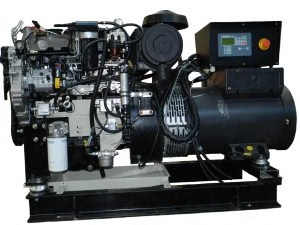
The innovation consists in installing a special generator set, which takes over the idling if the locomotive is not in traction mode. The generator set is the locomotive's third "inexhaustible" energy source that completely takes over the functions of the traction diesel engine when it operates idling for periods longer than 30 minutes, and the locomotive does not develop traction mode. This, without limiting the functions when stationary or moving, with a train or isolated.
The third energy source has two operating modes. When the locomotive is active, the control is manual and is carried out by the mechanic who decides, depending on the operating conditions, which diesel engine is operating. When the locomotive is stationary, the control is automatic depending on the coolant temperature and the battery voltage.
We must keep in mind that this locomotive will be operated for about 20 more years.
Effects of modernization
Obviously, such a modernization does not reduce the specific diesel fuel consumption of the diesel engine. However, by reducing its operating time, the overall diesel fuel consumption of the locomotive decreases. Mihai Marcu presents some data resulting from the implementation of the system on the locomotives of a major railway operator on the Romanian market. What are the conclusions?

Locomotive LDE-BR232. Source Wikipedia
The annual operating time of a locomotive is on average 5,800 hours. A reduction in running time on the 50% achieved by carrying out the modernizations leads to a diesel fuel saving of 11 kilograms per hour, translated into savings of 25 tons per year and locomotive. Furthermore, in terms of oil consumed, a saving of 12.5 kilograms per ton of fuel appears.
All of this means that the investment in the four systems installed by TEHMIN on the locomotive can be amortized in a period of 12-22 months, under two years.

The advantages presented by TEHMIN solutions
The implementation of the third energy source has multiple advantages, including:
- Reduces hourly diesel consumption by about six times (from 24kg to 4kg);
- For the same locomotive activity, a 700 kg assembly is used compared to a 28 ton one, i.e. 40 times less;
- The operating time of the traction diesel engine is reduced by approximately 50%;
- The annual diesel fuel savings are over 25t;
- The maintenance costs of the 28-ton group are reduced in proportion to the reduction in operating time;
The average hourly diesel consumption of the auxiliary group is approximately 4kg; Environmental pollution is reduced proportionally to the reduction in diesel and oil consumption.
There are also funny situations. The engineer says that he talked to several people who operate such locomotives and they all asked him and were interested in a system that would protect them against fuel theft. "I asked them, how much do you think is stolen? They answered that approximately 1-2 tons per year/locomotive. I'm sorry that it is stolen, I don't have a solution, but still that diesel helps something, someone, maybe they heat it with it or use it for agricultural work. I think we should also be concerned about the most important loss of diesel, the one that comes out the chimney, pollutes the environment and also wears out the diesel engine, without helping anyone, about 25 tons.
This represents the first technical solution applied by TEHMIN, namely the installation for reducing idling time. The other three components, namely the one for increasing the efficiency of the diesel traction engine, the economical ventilation of the traction engines and the locomotive diagnostic system, will be presented separately by Club Feroviar.

Who is TEHMIN-BRAȘOV?
TEHMIN-BRAȘOV SRL – solutions for improving the quality of passenger transport applied to rolling stockS.C. TEHMIN-BRAȘOV SRL is a company founded in 2002, out of the desire to put into practice a series of technical ideas in the field of rolling stock. The entire production of the company is based on research and innovation and is intended for construction, modernization and operation companies in the railway field, but with possibilities of expansion to other fields. TEHMIN is involved in the design and delivery of specific solutions for electrical systems; management, command and diagnosis of trains; communication systems and passenger information systems, both for new trains and those in operation.
The activity is supported by three design departments: electrical and automation, electronics and mechanics, with their laboratories. Starting with 2011, TEHMIN is also involved in the repairs of various subsystems (displays, air conditioning control machines, toilet control, door control, sources, converters, inverters, etc.).
The company has set itself the objective of modernizing locomotives, railcars, passenger cars or other railway equipment, pursuing the three main directions of activity:
Reducing energy and fuel consumption in the process of operating motor rolling stock, in order to reduce pollution and transport costs;
Mechanization and automation of controls on railway vehicles with the aim of optimizing control and operation processes and highlighting any deviations in real time;
Increasing product reliability and safety in rail transport.
Engineer Mihai Marcu hopes that TEHMIN solutions will be implemented by as many companies in the railway field as possible, especially since such projects have a chance of receiving European funding for environmental protection. (DC)