
Customers for SEELD systems


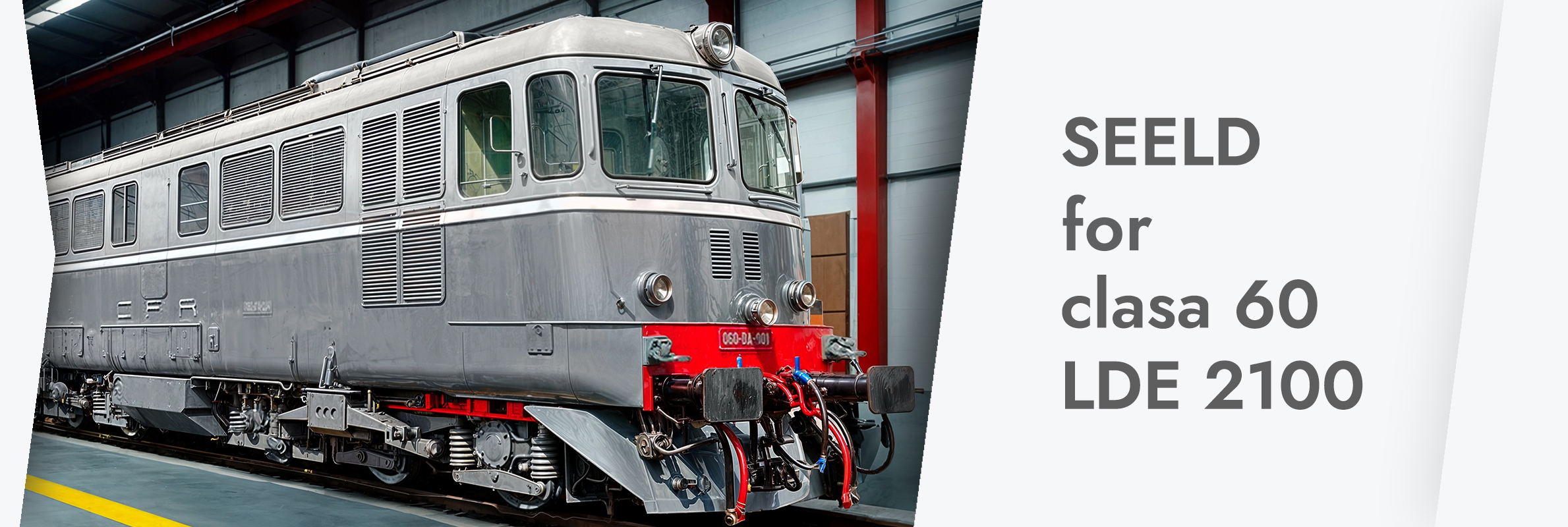
SEELD for Class 060 DA 2100
Solutions to reduce fuel consumption and increase reliability.
The current state of the locomotives from a technical point of view leads to high costs of transport, maintenance and fuel. The solution to reduce expenses is the technical adaptation of these locomotives to the actual operating conditions.
Tehmin Brasov proposes the following solutions for the economical operation of the locomotive, which once implemented can make the operation and maintenance predictable, simultaneously with cost optimization:

Reducing Idling Time
– the third source of energy
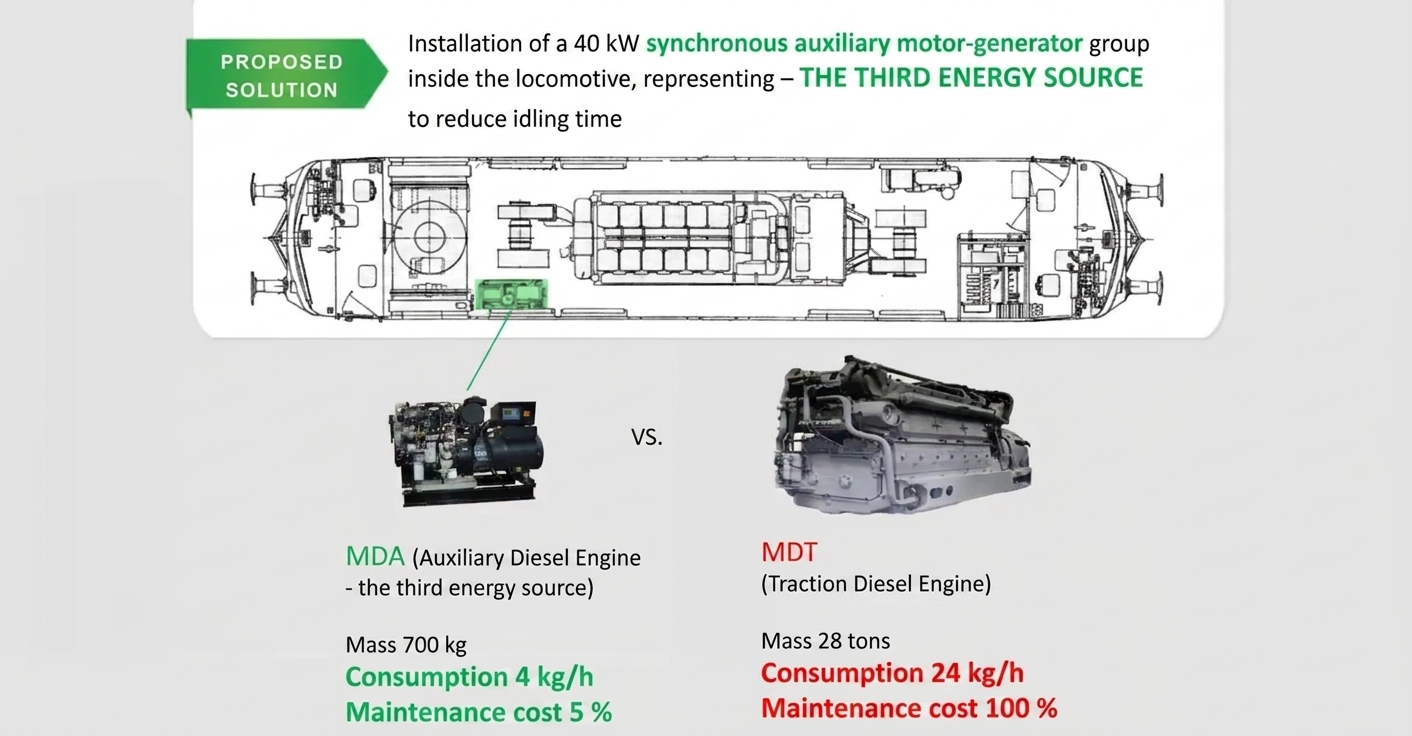
The MDA (Auxiliary Diesel Engine – the third source of energy) completely takes over the functions of the MDT when the locomotive does not develop the traction regime, regardless of whether it is stationary or moving.
MDA ensures:
- Keeping the diesel engine warm
- Charging the batteries
- Air compressor operation
- Heating / air conditioning of the driver's cabin
- Lighting and controls
- Other low power auxiliary services
- Reduction of operating hours of the MDT (traction diesel engine) with 52 %
- Reduction of diesel consumption from 24 kg/h to 4 kg/h, that is, 6 times less
- Oil consumption decreases proportionally with the decrease in diesel consumption
- Maintenance costs for MDT decrease with 30%
- Increases locomotive availability with 20%
- The period between revisions increases by 20%
- Instead of 28000 kg (MDT with generators and auxiliary services) we can use a 700 kg assembly (MDA), that is, 40 times less
- Reduces environmental pollution
- Monitoring the operating parameters of the locomotive
- Amortization of the investment between 12-22 months
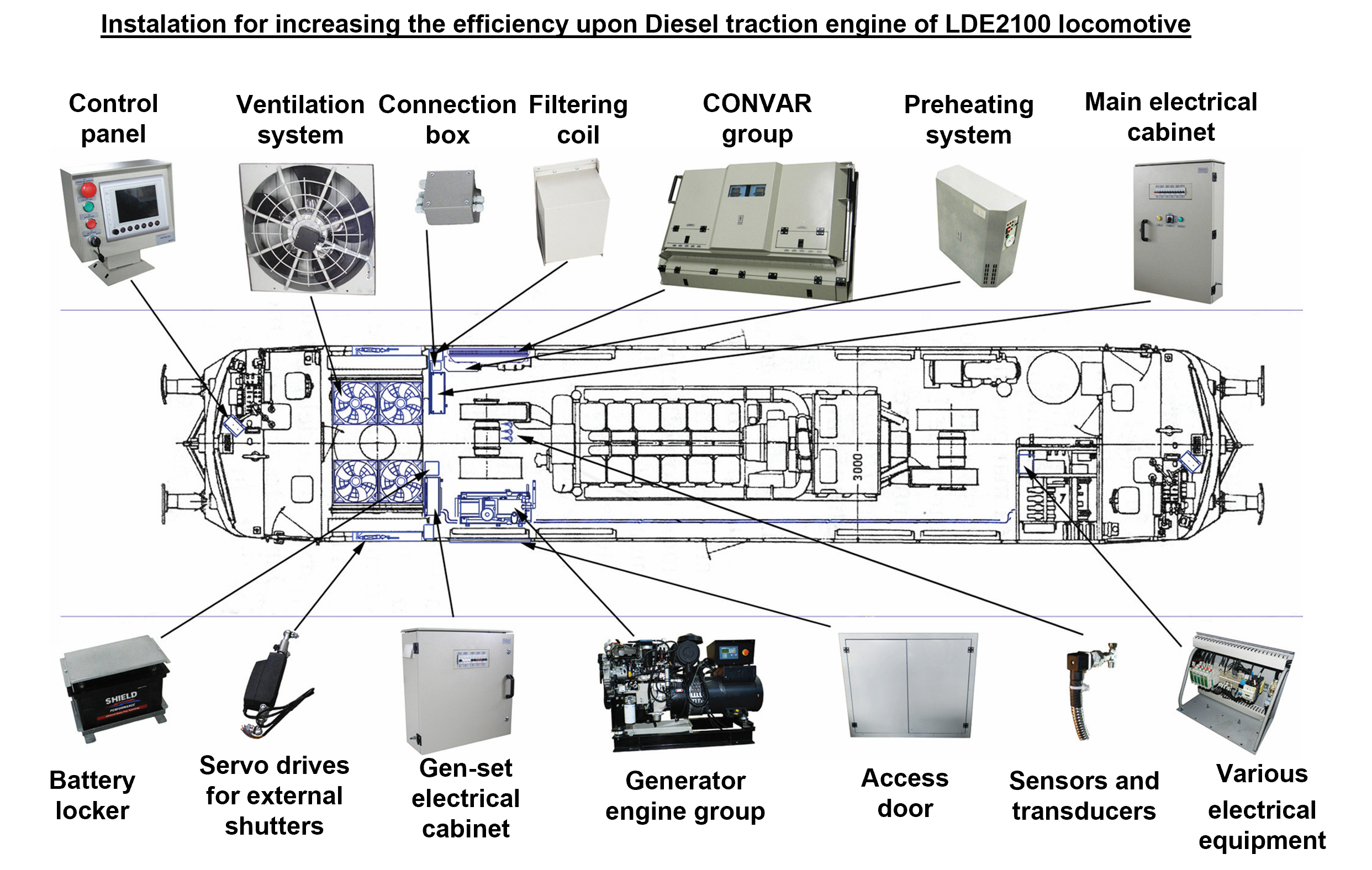

Increasing Efficiency
Diesel Traction Engine
Electric Ventilation of Radiators with Interior Blinds
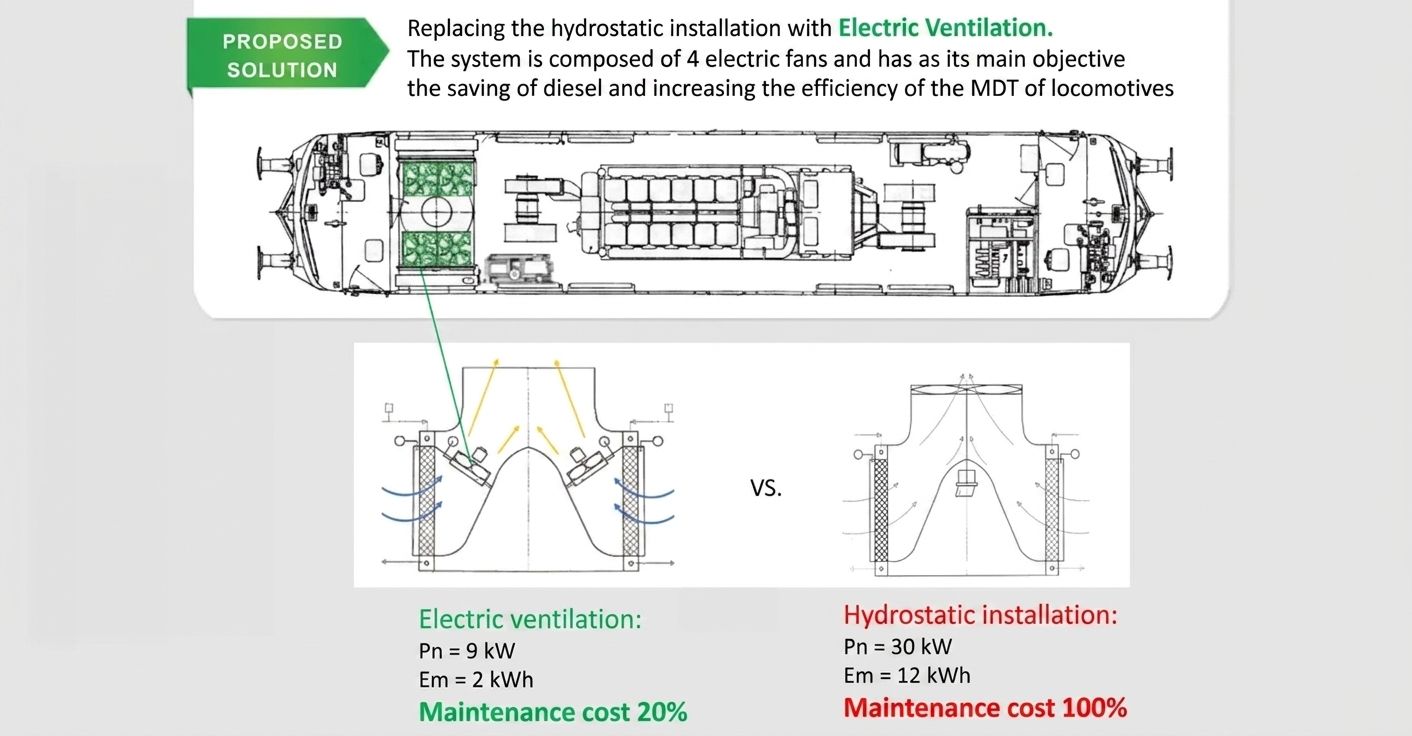
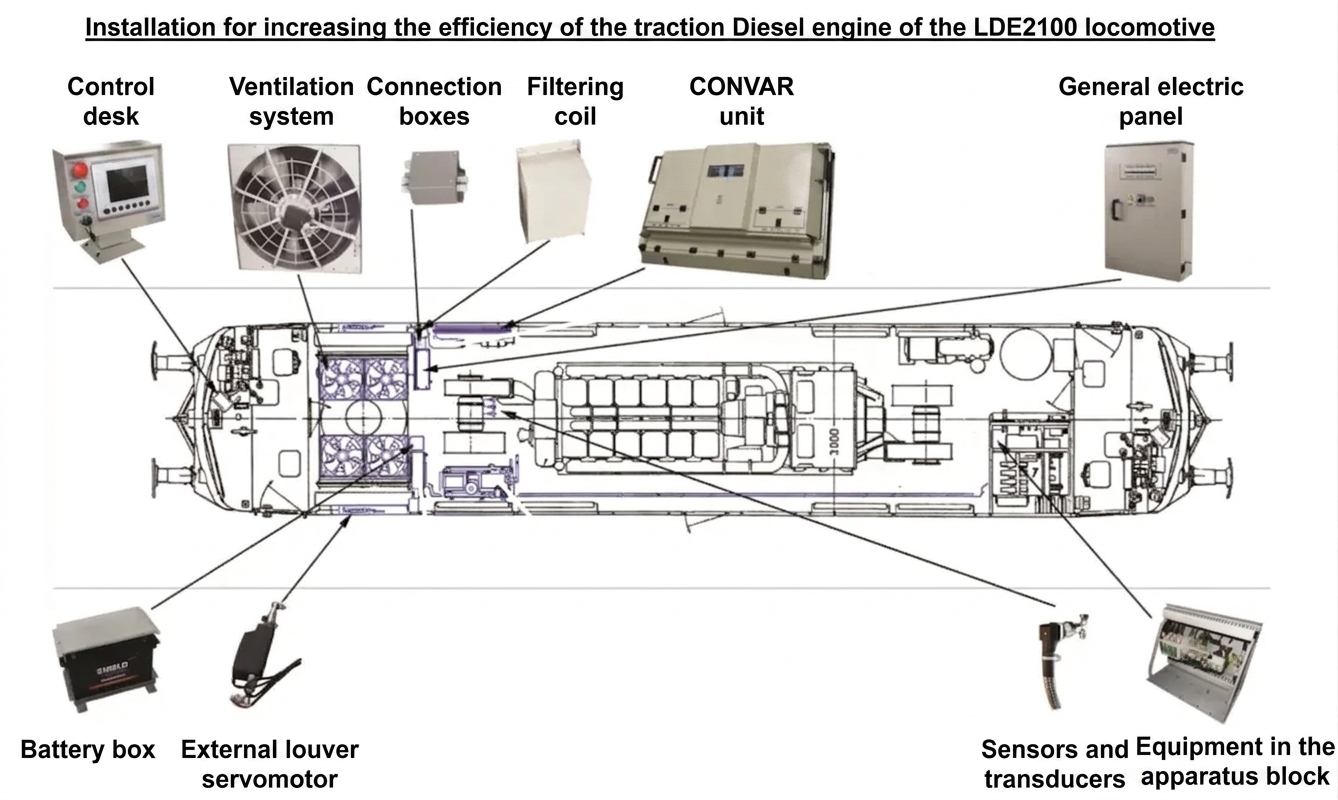
A system of four electric fans, two on each branch of radiators, provided with internal blinds.
The external and internal blinds are actuated with servomotors that close or open depending on the temperature of the cooling liquid, commanded by the temperature sensors by a central automatic.
The installation ensures operating conditions of the Diesel engine at a high efficiency due to the improvement of the thermal operating regime through the automation system.
The objectives of the installation:
- Operation of the Diesel traction engine in the optimal temperature regime to ensure minimum fuel consumption at all times
- Reducing energy consumption to keep the traction motor warm
- Removing the additional energy consumption of the ventilation when the thermal regime of the engine is below the optimal value
- Reduces MDT fuel consumption
- Removes heat losses from radiators when the temperature is below the optimal operating temperature by closing the external and internal blinds
- It ensures the operation of the Diesel engine at the optimal temperature
- It reduces the polluting effect of diesel engine exhaust gases and hydrostatic oil
- The energy consumed by ventilation is directly proportional to the temperature of the cooling liquid
- The ventilation works for about 50 % of the operating time of the MDT
- Eliminates energy consumption for driving the hydrostatic pump
- It does not require maintenance or consumables

Economical Ventilation
Electric Traction Motors
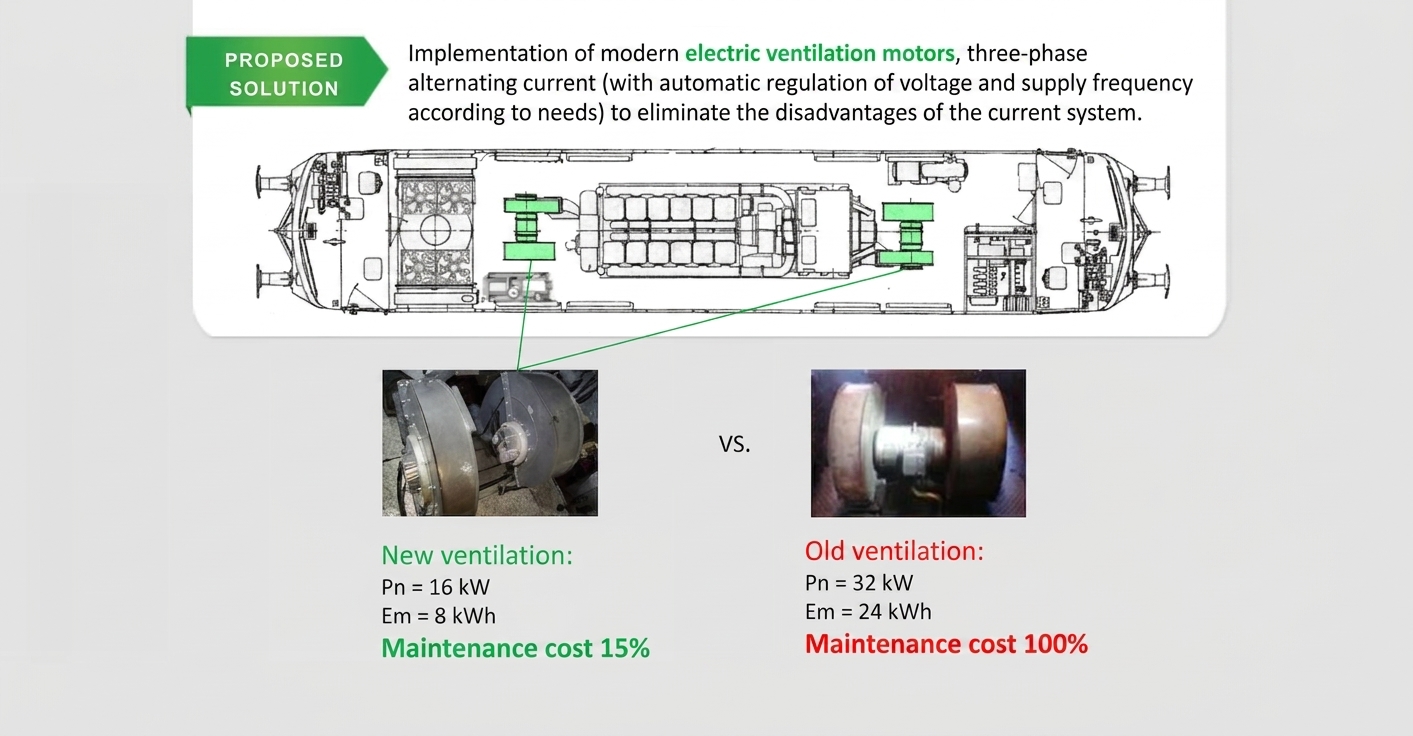
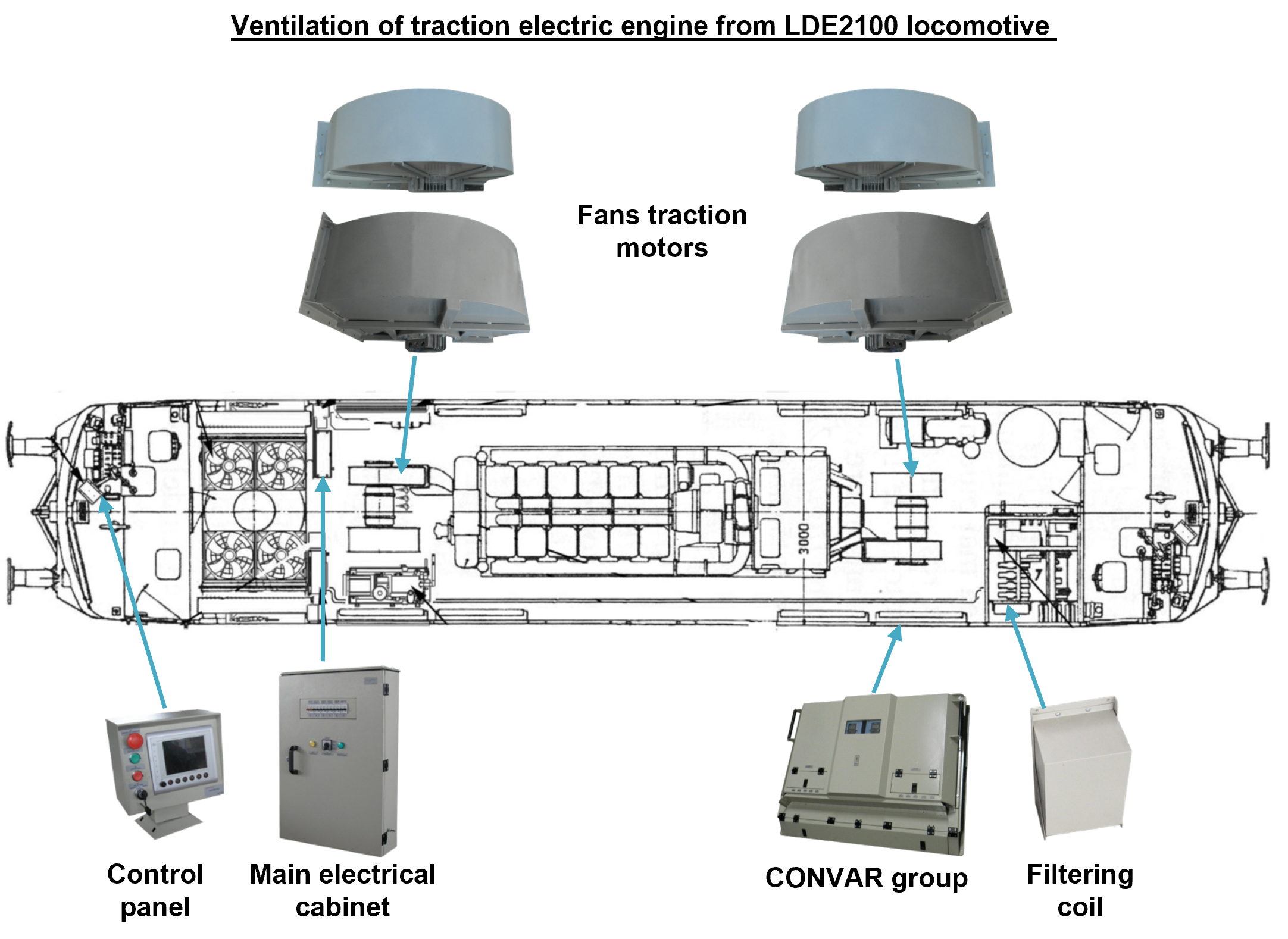
Modern, pilot-operated electric ventilation motors are used, with automatic voltage and frequency adjustment according to needs.
An electric motor with its own fan is mounted on each ventilation screw with a power of 5 kW for the ventilation of two traction motors and 3 kW for one traction motor.
The adjustment of the air flow is done automatically depending on the temperature of the environment and the value of the load current of the electric traction motors
- Electric motors require no maintenance or consumables for 10 years
- Energy consumption is three times smaller – lower fuel consumption for the diesel traction engine
- The electric motor supply system has no contactors
- The same automatic command, display and memory card are used as in the ventilation installation of the cooling radiators
- Increases accessibility in the front parts of the diesel engine and generators
- The reliability of the locomotive increases and the immobilization during overhaul is reduced
Diagnosis and Parameters
Locomotive Operation
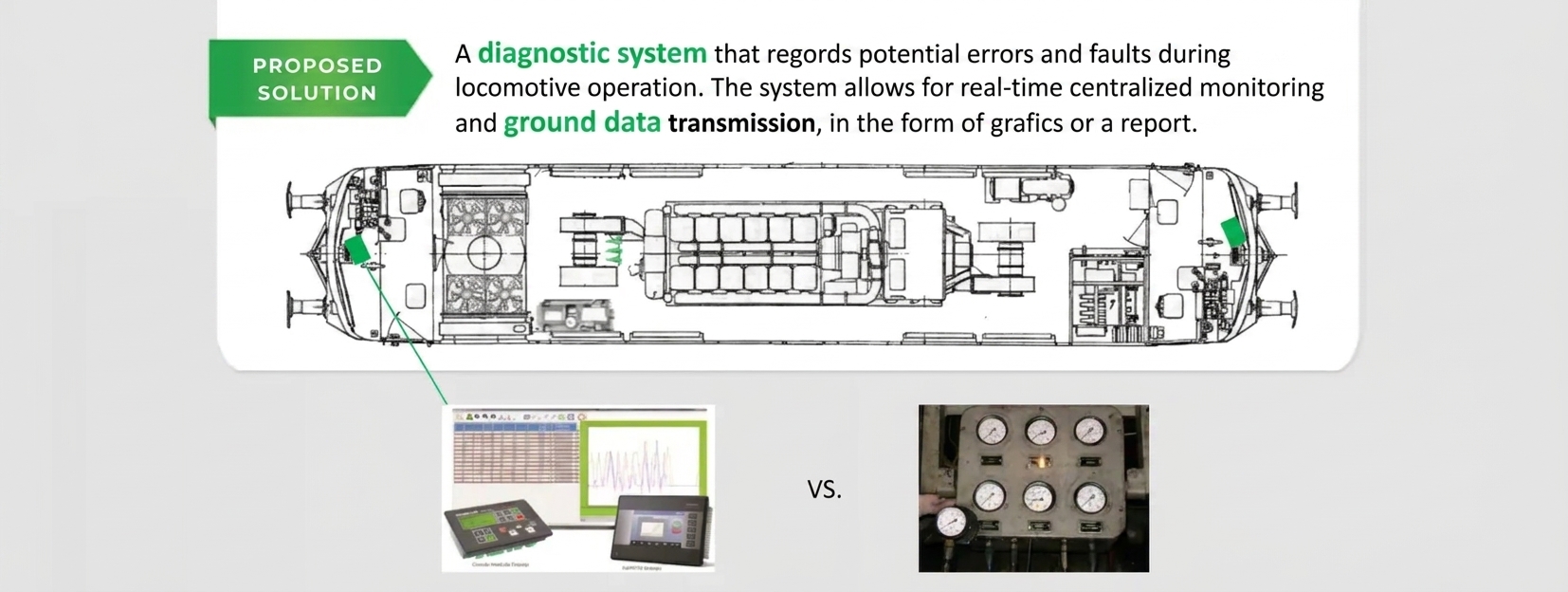
Examples of monitored parameters:
- Battery charging current
- Diesel engine speed
- Cooling water temperature and pressure
- Oil temperature and pressure
- Boost air pressure
- Main generator power
- Oil pressure at the inlet and outlet of the combined oil filter
- The current on the traction motor groups
- Air pressure in the general pipe
- The temperature of the support bearings of the traction motors.
All operating parameters are transmitted to the ground and displayed in the driver's station on a color display and are recorded on a memory card, and failures are transmitted by email to the ground and are displayed on the display.
The mechanic can focus on traffic safety.
The entire locomotive fleet can be tracked in real time from the office, on a computer.
With the help of this system you can track:
- Technical condition of the locomotive
- Traffic safety by analyzing the air pressure in the general pipe and the brake cylinders.
- Economic efficiency:
- the energy consumed in traction mode
- energy consumed by auxiliary services
- the total operating time of the Diesel engine under load and at idle


Hydrostatic Installation
- the new optimized method of operation
Digitalized control of the hydrostatic regulator.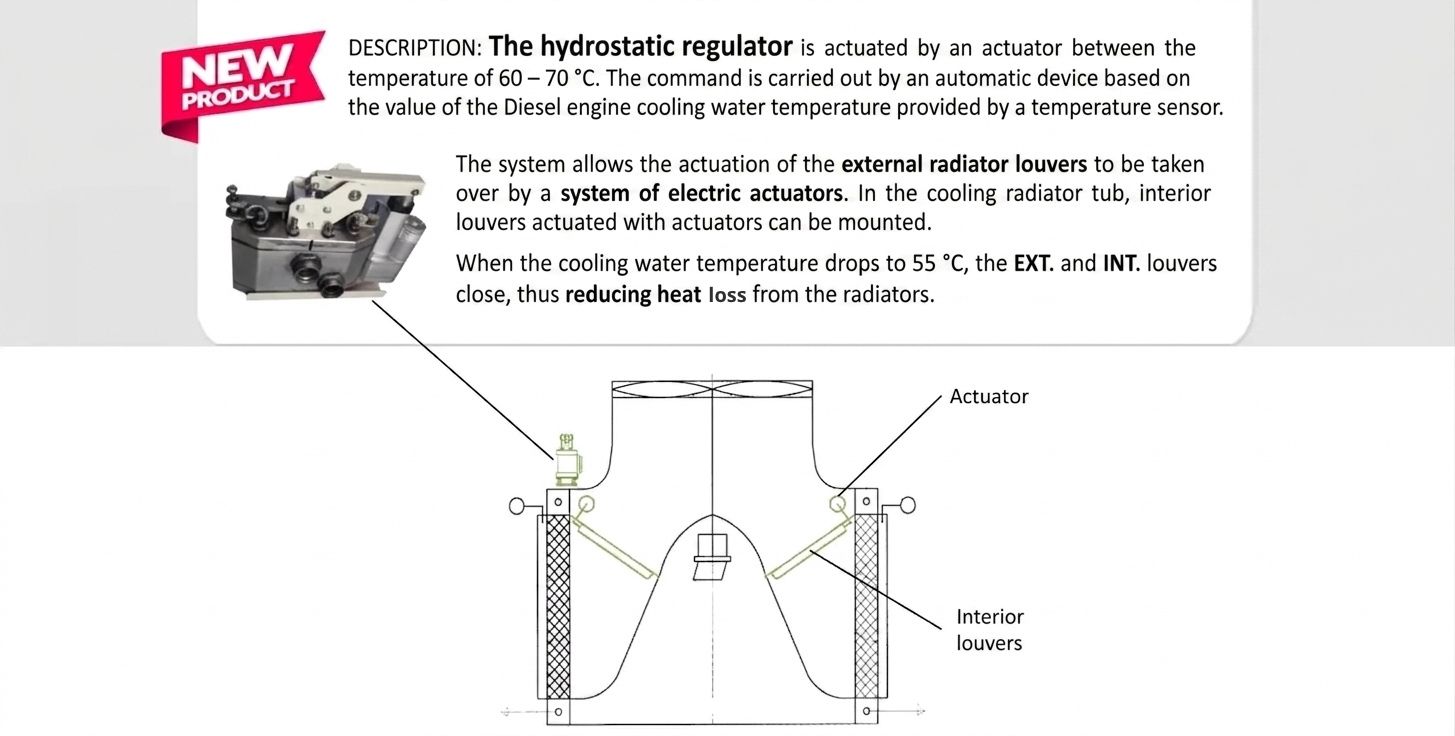
The hydrostatic installation on diesel and self-propelled locomotives has the role of ensuring the ventilation of the radiators for the cooling liquid of the diesel engine.
The installation consists of:
– a pump driven by the diesel engine
- a hydrostatic motor on the axis of which a fan is mounted, located in the cooling radiators
– an oil tank
– the hydrostatic regulator with one or two thermocouples mounted on the coolant pipe at the diesel engine exit
- two hydraulic cylinders for closing and opening the louvres of the radiators
The hydrostatic regulator has the role of regulating the speed of the fan, respectively of the air flow that circulates through the radiators to cool the coolant of the diesel engine and at the same time to close or open the louvres of the cooling tank of the radiators, so that the diesel engine operates at the optimal thermal regime established by its builder.
The thermocouples are mounted on the hydrostatic regulator being in permanent contact with the cooling liquid of the diesel engine, they have the role of thermostatically controlling the regulator depending on the temperature of the liquid at the exit from the diesel engine.
The situation in the operation of the hydrostatic installation on the motor railway vehicles showed that the thermocouples have low reliability, which is why diesel engines operate uneconomically from the point of view of fuel consumption.
The hydrostatic regulator, in case of failure of one or both thermocouples, is adjusted manually with the help of an adjustment screw corresponding to a given situation. When the operating conditions of the diesel engine change, the hydrostatic installation no longer has the ability to comply with the new conditions.
For this reason, the diesel engine is operated at abnormal temperatures below the optimal value, which lead to overconsumption of diesel but also to high mechanical wear.
- Reduces energy consumption for preheating and keeping the diesel traction engine warm
- Reduces diesel consumption when the Diesel traction engine is running at idle at 350 rpm
- The dynamic contraction forces from the mass of the radiators are reduced, extending their industrial life
- It prevents the operation of the Diesel traction engine at temperatures below 55 °C, eliminating fuel overconsumption
Customers for SEELD systems